

FY27 tax bills, covering July 2026 to June 2027, will arrive in the mail soon. The first payment is due by September 15, 2026. Please note that postmarks are no longer accepted as timely payments for property taxes. Payments must be received in the City office by 4:30 p.m. on the due date to be considered on time and avoid penalty charges. With the recent reappraisal, many residents want to know how their taxes are calculated and what changes might appear on their bills.
How Does the Reappraisal Affect My Bill?
The reappraisal itself does not increase the total amount of money the City collects. Instead, it redistributes each property owner’s share based on updated property values. While the City’s overall budget, approved by voters in April, remains at $12,921,469, with $11,891,682 to be raised from property taxes, the reappraisal has increased the overall grand list value. As a result, the tax rate has been lowered, but individual bills may rise or fall depending on how a property’s value changed relative to others.
How Are City Tax Rates Broken Down?
Because of the reappraisal, FY27 tax bills are based on the Abstract Grand List filed with the City Clerk on June 24, before any changes from grievances. After the grievance process ends, likely in mid-August, the final grand list will be filed. Revised tax bills may be issued if grievance decisions result in valuation changes.
The FY27 tax bill includes both City and State Education taxes, broken down as follows:
- General Fund: This pays for the City’s general operations. The rate is lower this year because property values went up due to the reappraisal.
- Tax Agreement: This covers State Education taxes for 47 veteran-owned properties that are exempt under state law. This rate also went down due to the reappraisal.
- Economic Development: This one-cent tax, re-approved by voters in 2024, funds capital improvements for economic development. It will be voted on again in 2027.
- Social Services: This one-cent tax, approved in 2026, supports local social service organizations that help Essex Junction residents. It will be voted on each year.
The table at the top summarizes the changes in each of the City’s tax rates from FY26 to FY27.
Where Does the Tax Revenue Come From?
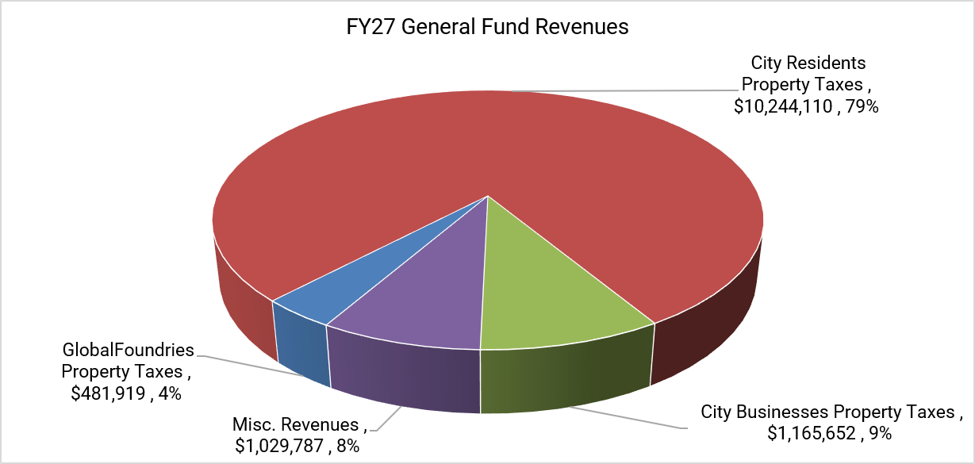
The City collects property taxes from residents, businesses, and other sources. When the budget was approved in April, the revenue projections between residential and commercial properties were based on the 2025 grand list proportional values. With the reappraisal, there has been a shift in proportional value from commercial/business to residential. This shift is described here and in Chart 1:
- City residents’ property taxes: $10,244,110 (79%), up 3%
- City businesses’ property taxes: $1,165,652 (9%), down 1%
- Miscellaneous revenues (non-tax revenue): $1,029,787 (8%), unchanged
- GlobalFoundries property taxes: $481,919 (4%), down 2%
What Does Your Tax Dollars Pay For?
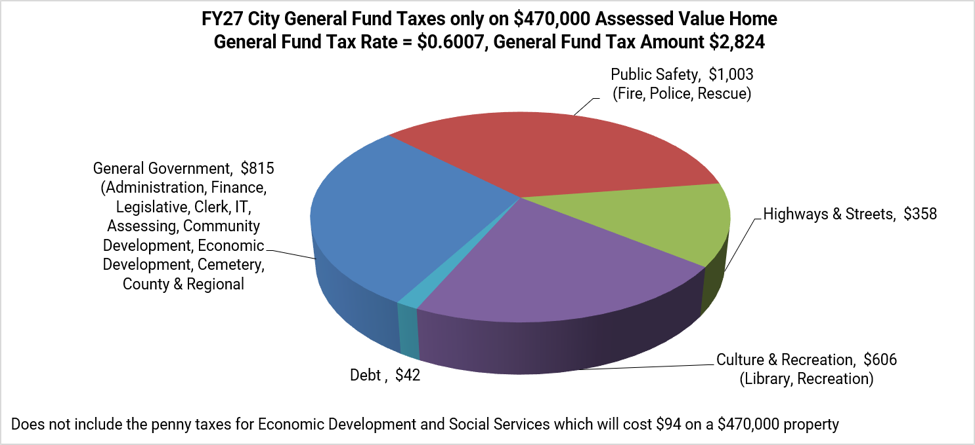
The City General Fund tax supports the City’s general operations. Chart 2 breaks down these expenses based on an average $470,000 home (this increased from the prior $280,000 average home value). You can find the approved FY27 budget, with expenses by department, at www.essexjunction.org/departments/finance/budget.
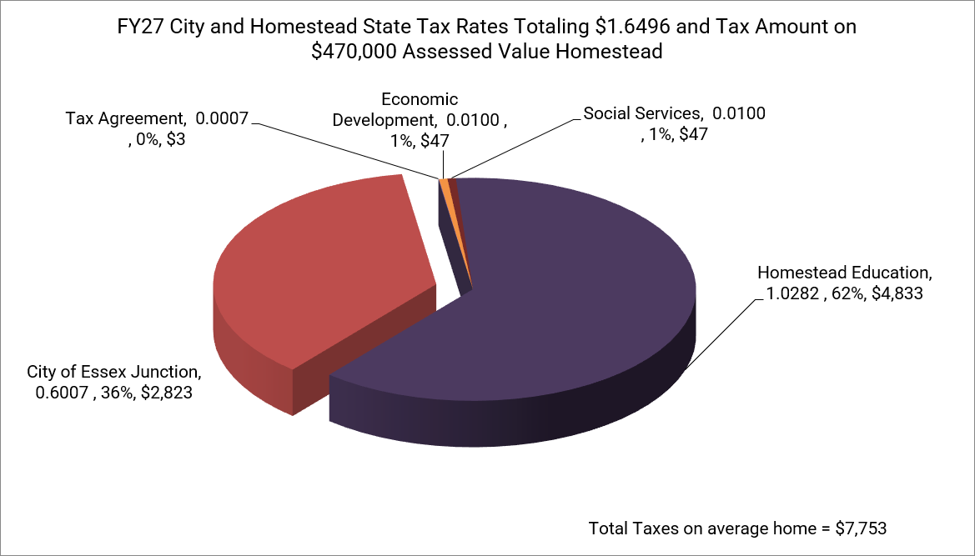
Your tax bill includes both City and State Education taxes. Chart 3 shows the breakdown and associated cost for each of the four City tax rates (totaling $0.6214) and the State Homestead Education rate of $1.0282 on a $470,000 assessed home.
For more information about the reappraisal process, visit the assessing department’s website at https://www.essexvt.gov/250/ASSESSING. You can also find details about homestead declarations and state credits in the insert that comes with your tax bill.