Park Street Complete Streets Improvements
Project Area
Park Street, from Railroad Street (the Crescent Connector) to River Street.
Project Phase
On April 29, 2026, the City Council voted 5-0 to select Alternative 1, Buffered Bike Lanes. Final design is complete. Construction is anticipated this fall.
What’s Changing
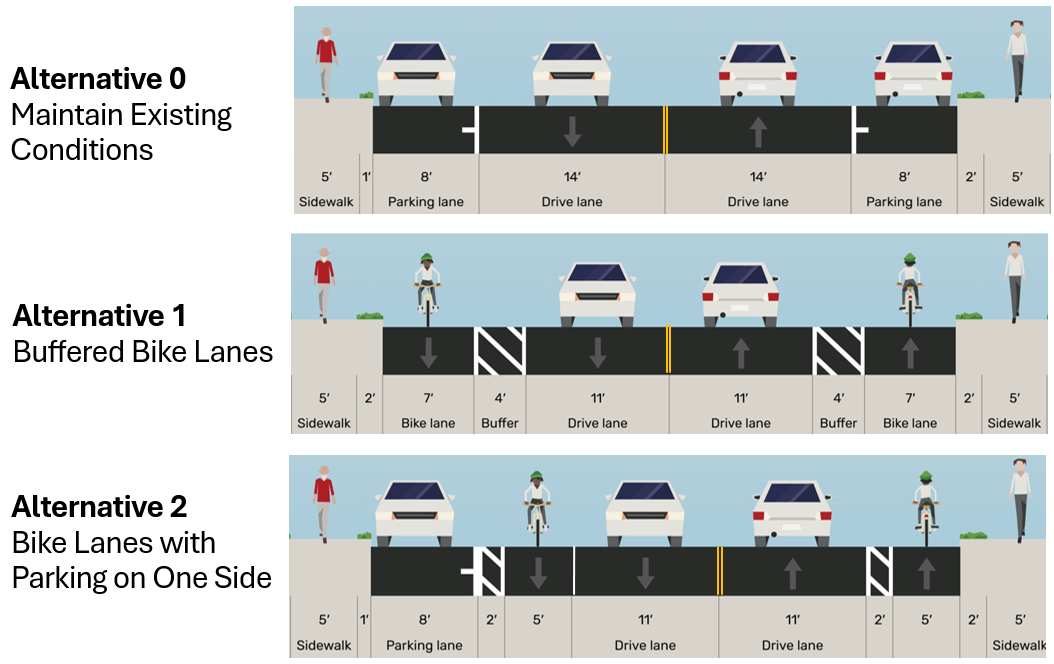
Park Street will be restriped between Railroad Street and River Street. The new layout adds a bike lane in each direction, with a painted buffer between the bike lane and moving traffic. The pavement is not changing, and the street keeps one travel lane in each direction.
To make room for the bike lanes, most on-street parking in the project area will be removed.
Parking will still be close by:
- On-street: spaces remain on the west side of Park Street between Railroad Street and the southern train tracks.
- Municipal lots: the Park Street School lot and spaces along Railroad Street.
- Business lots: businesses along this stretch have their own off-street parking.
Project Overview
Park Street is a gap in the City's bicycle network. This stretch has no dedicated bike facilities, and residents and stakeholders have flagged it as a priority for safer multimodal access.
The City studied three striping alternatives, all achievable within the existing pavement width:
- Alternative 0 – Existing Conditions: No changes to on-street parking or roadway striping. Serves as a baseline for comparison.
- Alternative 1 – Buffered Bike Lanes: Remove all on-street parking in the project area to add north- and southbound bicycle lanes with wide safety buffers.
- Alternative 2 – Bike Lanes with Parking on One Side: Remove on-street parking on the east side only to add bicycle lanes with modest safety buffers where possible
All three were evaluated for the same goals: filling the bike network gap, calming traffic by narrowing travel lanes, and keeping conditions safe for drivers, pedestrians, and cyclists.
Project Documents
Design Alternatives Slide Deck (Updated April 24 2026)
Parking Utilization Count Summary
April 13, 2026 BWAC Meeting Minutes
Project History
To help guide this project, the City is seeking your feedback:
Public Survey: closed April 6, 2026. 149 people responded. A summary is available above.
Bike Walk Advisory Committee: met April 13, 2026 and voted 5-0 to recommend Alternative 1 to the City Council.
City Council:selected Alternative 1 on April 29, 2026 by a vote of 5-0.. Following Council’s decision, staff will proceed with final design and implementation.